
 A medical machined parts manufacturer carries a different kind of responsibility than a general job shop. A housing that’s a few thousandths out, a fitting that won’t survive the autoclave, or a part made from untraceable stock can hold up a device build, fail an audit, or force a recall. Medical OEMs need parts that match the print every time, made from material they can document.
At Reading Advanced Machining (RAM), we machine precision components from advanced plastics and metals for diagnostic equipment, surgical tools, and laboratory devices. Here’s what medical work demands and how we approach it.
Medical parts are held to tighter expectations for consistency, cleanliness, and documentation than most industrial components. Many go into devices that diagnose or treat patients, so a dimensional or material problem isn’t a cosmetic issue. It can affect how the device performs, how it’s cleaned, or whether it passes the manufacturer’s own quality checks.
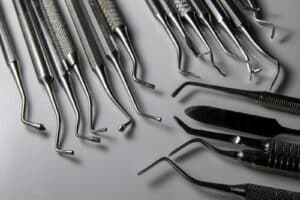
The range of parts is wide. CNC machining supports surgical instruments, implant hardware, and components for medical machines, with some features small enough to measure in fractions of a millimeter. On the equipment side, the work includes manifolds, housings, insulators, fixtures, and wear parts for diagnostic, lab, and imaging systems.
What ties these together is repeatability. A device manufacturer qualifies a part once and expects every later lot to behave the same way.
The right material depends on what the part touches, how it’s cleaned, and what load or heat it sees. Most medical machined parts fall into two groups.
Metals. Stainless steel is the long-standing default because it resists corrosion and machines well; by one common estimate, about four out of five medical devices use it. Titanium is popular where strength-to-weight and corrosion resistance matter. Aluminum shows up in equipment frames, housings, and fixtures rather than patient-contact parts.
High-performance plastics. PEEK combines strength, stiffness, and resistance to repeated sterilization. Ultem (PEI) offers good heat resistance and dimensional stability for instrument and equipment parts. Radel (PPSU) is known for standing up to many autoclave cycles. PTFE covers low-friction and chemically inert needs.
We machine aluminum, brass, copper, stainless steel, and titanium, and we stock roughly 190 plastic materials and brands, including medical grade plastics, PEEK, Ultem, Radel, and PTFE. If you want background on how plastics are rated for body contact, our introduction to biocompatible plastics covers the basics.
Sterilization is often the deciding factor between two materials that look similar on paper. Steam autoclaving exposes parts to high heat, moisture, and pressure over and over. Chemical disinfectants can stress-crack some plastics. Gamma and other radiation methods can make certain polymers brittle over time.
That’s why reusable instruments and equipment parts usually call for materials with a track record in the chosen method, while single-use parts may have more room. When a print specifies a material and sterilization method, our job is to machine that material without adding stress, contamination, or surface damage that would shorten its life.
Medical parts often carry tight tolerances on mating features, bores, and sealing surfaces, and they need clean finishes that won’t trap debris. We hold tolerances as tight as +/-.001″ on many plastic and metal parts, depending on material and geometry.
Holding that number on a plastic is a process question as much as a machine question. Our CNC milling, turning, and routing centers run DMG, Mori, Haas, and Heian machines calibrated for thermal compensation. Renishaw probes set tool and fixture offsets, and vacuum work-holding keeps parts still without clamping distortion. You can see the full equipment and materials list on our CNC manufacturing page.
Every part must pass an ISO 9001:2015-compliant quality inspection before it ships. Our inspection room includes an OGP Smartscope Flash 500 vision measuring system, a Helmel manual CMM, a Brown & Sharpe optical comparator, Mitutoyo profilometers for surface finish, and pin gages, calipers, and micrometers.
We work from stress-relieved, certified, traceable material, so lot and batch information can follow the part. That documentation supports the device maker’s own records, which is where biocompatibility and regulatory responsibility ultimately sit.
What does a medical machined parts manufacturer make? Typical work includes components for surgical instruments, diagnostic and lab equipment, device housings, manifolds, insulators, and fixtures, machined from plastics like PEEK and Ultem or metals like stainless steel and titanium.
Can machined plastics be sterilized? Many can. PEEK and Radel are known for handling repeated steam sterilization, while other plastics are better suited to chemical, radiation, or single-use applications. The sterilization method should be settled before the material is specified.
Does RAM machine both plastic and metal medical parts? Yes. We machine high-performance plastics such as PEEK, Ultem, and PTFE, as well as stainless steel, titanium, and aluminum.
What tolerances can you hold on medical components? We hold tolerances as tight as +/-.001″ on many parts. Achievable tolerance depends on the material, feature size, and geometry.
Do you handle prototypes and production runs? Yes. We machine prototype quantities as well as ongoing production for device manufacturers.
If you’re looking for a custom machined parts manufacturer for medical components, send us your print. Request a quote or call 610-926-3245, and learn more about our medical industry work.


